How to Read Food Labels: Serving Size, Sugar and %DV
Revised · General adult food education
Read the quantity first, choose the nutrient question you are comparing, and keep ingredients and allergy checks separate. A nutrient number is useful only with its serving basis. The worked examples below use fictional labels so you can practice without treating a brand as the best choice.
Start with the label system and the amount
This walkthrough uses US Nutrition Facts terminology. Imported foods and products sold in other countries may show different headings, reference percentages or per-100-gram columns. Check the current package in your market before transferring a percentage from one label system to another.
Find the serving size and servings per container. Read the familiar measure together with its metric amount: a cup, slice or piece count may also have a gram weight. FDA explains that serving size reflects what people typically eat or drink, not how much you are being told to eat.
Then decide which amount you are discussing: the label’s serving, your planned portion or the entire package. If you eat two matching servings, the corresponding nutrient amounts are twice the per-serving amounts. A package containing two servings is not automatically a one-serving meal. If the label has both per-serving and per-container columns, use the column matching your question without adding the columns together.
Choose a comparison before choosing a winner
A label cannot answer “Which food is best?” without a more specific question. You might compare sodium between two soups, fiber between cereals, or added sugars between otherwise suitable products. Keep relevant dietary advice, allergies, price, preparation and what you actually intend to eat in view.
On a narrow screen, scroll this table sideways to read all columns.
| Fictional soup label | Reference amount | Sodium | Dietary fiber | Added sugars |
|---|---|---|---|---|
| A, as prepared | 200 g | 400 mg | 4 g | 2 g |
| B, as prepared | 100 g | 260 mg | 3 g | 1 g |
| B, calculated at A’s amount | 200 g | 520 mg | 6 g | 2 g |
The displayed sodium number for B is smaller, but its reference amount is half as large. At 200 g of either prepared soup, A’s fictional label gives less sodium and B gives more fiber; added sugars are equal in this example. That is a set of specific comparisons, not a nutritional ranking or measured analysis of a real soup.
Scale a nutrient using: listed amount × chosen quantity ÷ label reference quantity. Keep the quantity units and preparation state matched. Do not insert milliliters into a calculation based on grams unless you have an appropriate checked conversion. Dry soup powder and prepared soup are different comparison states.
For the narrower cereal question, use the per-serving versus per-100-gram cereal guide. It includes real, attributed manufacturer examples. This page supplies the wider sequence for reading a whole label.
Understand % Daily Value without confusing it with grams
% Daily Value, or %DV, describes how much a serving contributes to a daily reference amount for that nutrient. It is not the percentage of the food’s weight made from that nutrient. The percentages down a label are not pieces of one pie and do not need to add up to 100.
FDA’s general US guide treats 5% DV or less per serving as low and 20% DV or more as high. Use that guide with the stated serving quantity. A smaller serving can produce a smaller percentage without making the food less concentrated in the nutrient. Match the quantities when comparing products.
For example, “20% DV sodium” is not 20 mg sodium and not a claim that one fifth of the food is salt. Find the sodium milligrams and serving basis. Likewise, a fiber percentage is not fiber grams. If you need the amount for a calculation, use the nutrient row’s actual unit.
Daily Values are general label references. They do not assign a personal calorie requirement, medical sodium limit or breakfast target. If you have a prescribed dietary plan, use its instructions and ask your care team how to interpret relevant label information.
Total sugars already includes added sugars
On US labels, total sugars includes naturally present sugars and any added sugars in the product. The “includes added sugars” line is part of that total. Do not add it a second time.
A fictional yogurt lists 15 g total sugars, including 7 g added sugars, for one serving. Its total is 15 g, not 22 g. The difference in that example is 8 g sugars not classified as added. These figures teach the relationship; they are not a product recommendation or a personal sugar allowance.
Zero added sugars does not mean zero total sugars. Fruit and milk can contain naturally present sugars. A front-label “no added sugar” claim also does not describe every ingredient or non-sugar sweetener. Read the whole ingredients and any asterisk rather than assuming plain fruit and water. The breakfast fruit guide demonstrates that distinction with exact named products.
For an unlisted nutrient, keep the information unknown rather than entering zero. FDA notes that total sugars has no %DV and that protein %DV is not required on many general-population labels without a protein claim. A missing percentage is different from a missing gram amount.
Ingredients and allergy checks come before a nutrient preference
The Nutrition Facts panel does not replace ingredient information. FDA advises people with food allergies to read the whole ingredient list each time they purchase a food, because formulations can change. Not every allergen-containing product has a separate “Contains” statement.
For most packaged foods within the relevant US rules, major allergen sources are identified in ingredient wording, parentheses or a “Contains” statement. Read all the information appropriate to your allergy. This page does not certify that a food is safe for you or identify every possible allergy.
“May contain” and similar advisory wording has a different role from “Contains.” FDA explains that such advisory statements are voluntary. Their absence does not establish absence of cross-contact. If the actual product information leaves your allergy question unresolved, choose a suitable known alternative or ask the manufacturer; do not test a food by eating it.
Finish with one usable conclusion
Write the exact product, quantity and conclusion: “At 200 g prepared, A has less sodium in these example labels,” or “This current cereal has more fiber per 100 g.” Then note the other checks that affect the purchase. A front-label word such as “healthy,” a single nutrient or a smaller declared serving is not the whole decision.
The meal-led grocery list keeps the chosen food connected to actual meals and usable stock. If you want a nutrient estimate for several breakfast ingredients, use the breakfast label calculator. If numbers do not serve your task or increase distress, you can choose suitable familiar foods without making every meal a calculation.
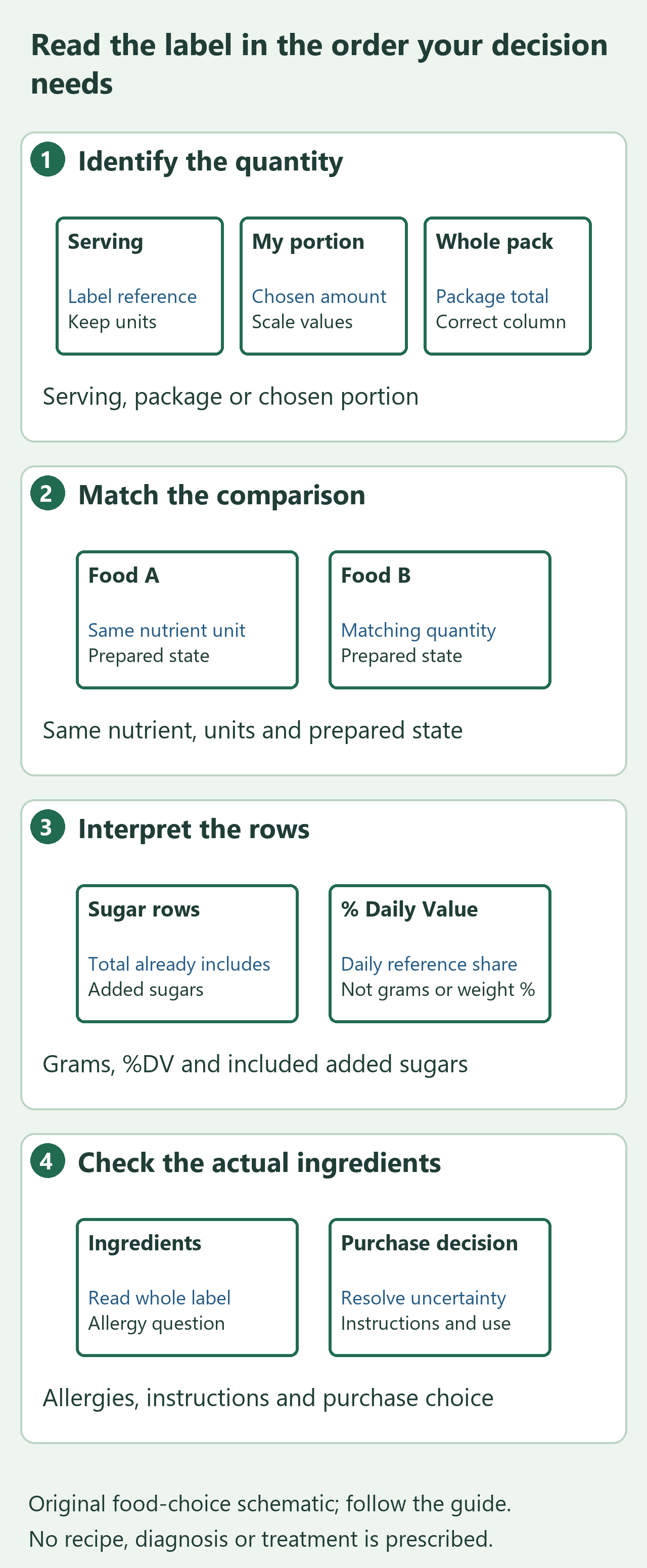
Read the label in the order your decision needs
Examples to work through
These fictional examples illustrate practical choices and observations.
The smaller sodium number belongs to a smaller serving
The fictional soups list 400 mg per 200 g and 260 mg per 100 g. At 200 g, the second becomes 520 mg. Compare prepared food at the same quantity before concluding which has less sodium. This does not rank all the foods’ nutritional qualities.
Total sugar and added sugar seem like two amounts to add
For a fictional label with 15 g total sugars including 7 g added sugars, total remains 15 g. Adding 7 again gives a wrong 22 g. Keep the reference serving with the calculation; the result is not an individual sugar prescription.
A nutrient percentage looks like a percentage of the food
20% DV means a contribution to the daily reference for that nutrient in the stated serving. It is not 20 g or 20% of the product’s weight. Use the actual gram, milligram or microgram row for quantity calculations.
There is no separate Contains or may-contain statement
Read the whole ingredient information and use advice relevant to your allergy. FDA says a separate Contains statement is not always present and advisory statements are voluntary. Their absence does not certify a product as suitable; resolve uncertainty before purchase.
Food-label comparison record
Use these optional reminders to mark fields you want to keep in your own notes. The downloadable blank sheet contains every record field. Keep your completed record in your own appropriate private place.
Frequently asked questions
Is the serving size how much I should eat?
FDA describes serving size as an amount typically consumed, not a recommendation of how much to eat. It is the reference for the listed nutrient figures. Your planned amount and any prescribed dietary plan remain separate decisions.
What do 5% and 20% Daily Value mean?
FDA’s general US guide treats 5% DV or less per serving as low and 20% DV or more as high. Keep the serving basis visible. Those percentages describe a daily reference contribution; they are not nutrient grams or a personal medical target.
Does zero added sugar mean the product has no sugar?
No. Total sugars can include naturally present sugars as well as added sugars. Read both rows and the ingredients. A no-added-sugar claim also does not establish that there are no other sweetening ingredients or that the food is suitable for a medical diet.
Can I compare US percentages with an imported product’s percentages?
Check the label system and reference definitions first. Matching nutrient units, food quantities and preparation states is clearer than treating different reference percentages as equivalent. Use current product information in your market, and leave unresolved conversions unknown.
Sources and what they support
- FDA: How to Understand and Use the Nutrition Facts Label
US serving quantities, matching comparisons, nutrient grams versus %DV, and added sugars already included in total sugars. The source is dated 5 March 2024; label references are not personal meal targets.
- FDA: Have Food Allergies? Read the Label
Whole ingredient checks, Contains versus voluntary advisory statements, and asking about unresolved product information. US packaged-food context; the source is dated 10 January 2023.
- NHS: The Eatwell Guide
Ordinary food groups, protein foods and balance over a day or week. The source displays a last-reviewed date of 29 November 2022; use individual advice for medical dietary requirements.
Sources were checked on 4 November 2026 UTC. The food-choice examples, arithmetic and blank records are original editorial aids, not tested recipes, nutrient analyses or medical assessments.