Practical guide
Scaling Overnight Oats: Portions, Containers and Ingredient Ratios
Multiply every ingredient by wanted portions divided by original recipe portions. Use a verified NHS four-portion example, keep evening mixing and morning toppings separate, and choose containers from the actual prepared portion. The ingredient calculator preserves units; storage and nutrient claims still need their own evidence.
Start with the recipe you are actually making
To scale overnight oats, divide the number of portions you want by the number in the original recipe. Multiply each ingredient by that same factor, keep its original unit and preserve the preparation stages. Changing the batch size does not establish a new container volume, nutritional analysis or storage life.
The worked example here uses the NHS Healthier Families easy overnight oats recipe, which serves four. It combines porridge oats, dried fruit and unsweetened apple juice the evening before, then adds natural yoghurt and berries in the morning. This is a specific juice-based recipe. It is not a universal milk-to-oats ratio or a claim that every overnight-oats mixture behaves identically.
Choose the number of recipe-sized portions that fits the people and next meal you are preparing. “One portion” here means one quarter of this source recipe, not a prescribed amount for every adult or child. If you need a different breakfast amount, choose that deliberately rather than assuming a recipe’s serving count is personal nutrition advice.
The calculations below are derived from the published ingredients. They have not been verified by cooking or tasting a batch. Follow the original method and your ingredients’ actual preparation, suitability and storage instructions.
Scale every ingredient, with the evening and morning stages separate
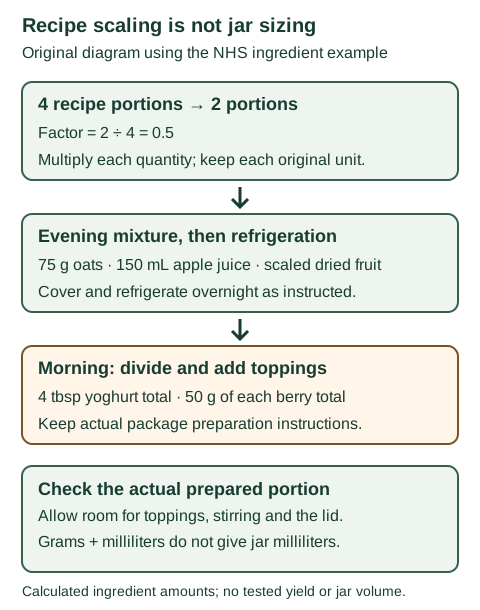
Scaling factor = wanted recipe-sized portions ÷ original recipe portions. For two portions from a four-portion recipe, the factor is 2 ÷ 4 = 0.5. The original 150 g oats becomes 75 g, and 300 mL apple juice becomes 150 mL. Each other ingredient is halved too.
The tables retain grams, milliliters and tablespoons exactly as the NHS source states them. They do not convert a spoonful of yoghurt into a gram weight or assume that grams of oats equal milliliters of oats. The original column is the published recipe; the other columns are our arithmetic.
| Ingredient | Original: 4 portions | Calculated: 1 portion | Calculated: 2 portions | Calculated: 6 portions |
|---|---|---|---|---|
| Porridge oats | 150 g | 37.5 g | 75 g | 225 g |
| Dried cranberries | 25 g | 6.25 g | 12.5 g | 37.5 g |
| Ready-to-eat apricots, chopped | 50 g | 12.5 g | 25 g | 75 g |
| Sultanas | 25 g | 6.25 g | 12.5 g | 37.5 g |
| Unsweetened apple juice | 300 mL | 75 mL | 150 mL | 450 mL |
Mix these evening ingredients as the source directs, cover and refrigerate overnight. The original method uses a large bowl and divides the soaked mixture the next morning. You do not need to buy four matching jars to follow that method.
| Ingredient | Original: 4 portions | Calculated: 1 portion | Calculated: 2 portions | Calculated: 6 portions |
|---|---|---|---|---|
| Low-fat natural yoghurt | 8 tbsp | 2 tbsp | 4 tbsp | 12 tbsp |
| Blueberries | 100 g | 25 g | 50 g | 150 g |
| Raspberries | 100 g | 25 g | 50 g | 150 g |
The source says to thaw frozen berries and adds them in the morning. Check the actual product too: a frozen bag that requires cooking should not be used uncooked just because the recipe mentions frozen berries. Choose ingredients with appropriate preparation instructions, or prepare them as required.
For six portions, the same calculation uses a factor of 6 ÷ 4 = 1.5: 225 g oats, 450 mL apple juice and 12 tablespoons yoghurt in total. The larger batch still needs its proper preparation stages and covered refrigeration; scaling ingredient quantities does not scale “overnight” into a longer soaking time.
Use the recipe-specific ingredient calculator
The starting example asks for two recipe-sized portions. You can also enter a fraction such as 0.5 when planning half of one source portion. The result says which ingredients belong in the evening mixture and which are morning additions, so an eight-tablespoon total is not confused with eight tablespoons per bowl.
Editing the portion input clears the previous result. Calculate again for the new number. The clear button removes both the number and result; a blank input is not treated as zero portions. There is no nutrient or safety score.
For another recipe, use its own original serving count and ingredient amounts in the same multiplication method. Do not put a milk-based recipe’s serving count into this tool and assume it has changed the listed NHS ingredients. Use the worked equation with that recipe instead.
Keep a practical distinction between arithmetic and measuring. A single scaled portion has 6.25 g cranberries because 25 ÷ 4 = 6.25. That does not mean your kitchen scale can measure a quarter gram reliably. Use appropriate equipment, record any approximate rounding, or choose a convenient small batch. Round at the end of the calculation, rather than rounding the scaling factor first and then multiplying every ingredient.
Choose containers from the actual portion and preparation
A jar’s advertised capacity is not the volume of the breakfast you will put inside it. Dry oats contain spaces between the pieces, absorb liquid and are mixed with other ingredients. You cannot add 150 g oats to 300 mL juice and call the result 450 mL of mixture.
Decide whether you want one covered mixing bowl or separate portion containers. The NHS method uses a shared bowl for overnight soaking, then cereal bowls in the morning. If you are adapting that into portable containers, keep the change visible and preserve refrigeration. Moving the same mixture into jars is a container choice, not a new shelf-life test.
Start with a clean container intended for food storage that can hold the actual mixture without being filled to the rim. Leave usable room to stir, add the planned toppings and close the lid without pressing food into it. There is no measured universal headspace percentage in this guide.
When packing a portion, check the actual filled amount in the container you have, with toppings if those will be packed too. If you want a volume measurement, measure the prepared portion with suitable equipment rather than converting its ingredient mass by guesswork. A small trial portion can help select a container; it does not prove a storage duration or microbial safety.
Keep the storage method compatible with your fridge space. FDA’s refrigerator guidance says to avoid overpacking because cold air needs to circulate, and to keep refrigerated foods covered. Six tightly wedged jars do not become safely chilled merely because their ingredient arithmetic is correct.
Label the batch without inventing a nutrient total
A useful preparation label identifies the recipe, the batch size, the date and time prepared, and the storage instruction you are following. If toppings are separate, label them or keep their instructions with the batch. A label should help someone else recognize the food, not imply a tested use-by date you do not have.
RECIPE AND PREPARATION RECORD
Recipe: NHS easy overnight oats, scaled from 4 portions
Wanted recipe-sized portions:
Factor: wanted portions / 4
Prepared date and time:
Evening mixture: oats, dried fruit and apple juice
Morning additions: yoghurt and prepared berries
Storage: covered refrigeration; follow ingredient instructions
Ingredient opening dates / use-within instructions:
Substitutions or approximate rounding:
Actual container and usable fill check:
Planned next meal:
Read the ingredient labels for the exact products you use. Keep the yoghurt’s opening date and any use-within instruction visible. Check oat, fruit and other ingredient suitability for your requirements. Recipe scaling cannot determine allergy or gluten-free suitability from a category name.
The FDA Nutrition Facts explanation says serving size is a reference for the listed nutrient amounts, not a recommendation of how much to eat. It also explains that nutrient amounts relate to that stated serving. A recipe-sized portion and your package’s serving can differ.
This calculator does not repeat the NHS recipe’s published nutrient values for your modified breakfast. Changing apple juice to milk, changing the yoghurt, omitting dried fruit or adding another ingredient changes the food represented by those values. Use the breakfast worksheet and label calculator for a separate label-based estimate with matching quantities; keep missing values unknown.
Keep overnight soaking in the fridge and storage instructions intact
In the source recipe, “overnight” means covered and refrigerated overnight. It does not mean leaving a dairy or fruit mixture on the kitchen counter until morning. Prepare with clean hands, utensils and food-storage containers, and follow the ingredients’ actual instructions.
FDA advises keeping the refrigerator at 40°F or below and checking it with an appliance thermometer. A dial position is not a measured food-storage temperature. If you use a Celsius display, 4°C is a practical lower target, rather than an exact conversion of 40°F. Keep food covered and separate from raw meat or leaking packages.
Return ingredients that require refrigeration promptly. FDA’s general rule for perishables is no more than two hours at room temperature, with a one-hour limit above 90°F. These are limits to avoid exceeding, not instructions to leave a bowl out while the timer runs. Overnight soaking belongs in the refrigerator from the start.
Scaling four portions to six does not make the recipe safe for six days. The NHS recipe describes preparation for the following morning and does not provide a validated week-long holding time for every variation. Follow the prepared recipe’s directions and each ingredient’s storage and use-within instructions. Make a manageable batch for the planned meal rather than assigning an unsupported date to a week’s worth of jars.
If a mixture with perishable ingredients has been left out all night, do not use a normal smell as a safety test or reset the clock by refrigerating it in the morning. FDA explains that food can cause illness without looking, smelling or tasting spoiled. Discard a batch whose handling has exceeded the applicable limits.
For frozen berries, preserve the package’s thawing or cooking instructions. The breakfast fruit label guide explains why one product’s ready-to-eat statement does not cover every frozen bag. This scaling page adds no new fruit-storage guarantee.
Save the ingredient record for the next batch
Download the ingredient scaling and preparation record. It includes the published four-portion ingredients, calculated one-, two- and six-portion amounts, the equation, a blank preparation label and six explained cases. Print or edit a copy for the recipe you actually make.
After preparing, note whether the container was convenient and whether you rounded a small ingredient quantity. If you add extra liquid for a texture you prefer, write the change and amount. It becomes your adaptation; it is no longer a strictly scaled version of the listed recipe.
The useful outcome is a batch you can recognize and prepare again with clear quantities and storage. A mathematically larger batch is not automatically cheaper, nutritionally better or more practical. Keep the preparation small enough to fit the meal and refrigeration space you have.
Six checks before preparing the scaled batch
These original cases separate batch arithmetic, container capacity, preparation stages, label values and refrigeration.
Case 1
The source recipe serves four with 150 g oats and 300 mL apple juice. You want two recipe-sized portions. What are the scaled quantities?
Show answer and explanation for case 1
75 g oats and 150 mL apple juice.
Use the factor 2 ÷ 4 = 0.5 for both ingredients and all the others. Keep grams and milliliters as their original units. This is ingredient arithmetic for the source recipe, not a personal serving recommendation or a measured jar volume.
Case 2
You double the oats but leave the apple juice and other ingredients unchanged. Is this the same recipe scaled to twice the portions?
Show answer and explanation for case 2
No. The ingredient proportions changed.
A strict batch-size scaling multiplies every ingredient by the same factor. You may choose an adaptation, but record it as a different mixture. Doubling only the oats does not establish twice the portions with the original preparation result.
Case 3
The original mixture uses 150 g oats and 300 mL juice. Does adding those numbers prove that a 450 mL jar will hold the mixture and toppings?
Show answer and explanation for case 3
No. Grams and milliliters cannot be added into a jar volume.
The quantities describe different units, and the prepared mixture also contains dried fruit and later toppings. Check the actual portion and usable fill, including room to stir and close the lid. This guide supplies no measured mixture yield or universal headspace percentage.
Case 4
The original four-portion recipe lists eight tablespoons yoghurt. Should each bowl get eight tablespoons before the overnight soak?
Show answer and explanation for case 4
No. The source adds two tablespoons per portion in the morning.
The eight-tablespoon figure is the total for four portions. Scaling to two portions gives four tablespoons total, still added at the morning stage. Keep total batch quantities, per-portion quantities and preparation timing separate.
Case 5
You replace apple juice with milk and add a new topping. Can you label your version with the unmodified recipe’s published nutrient values?
Show answer and explanation for case 5
No. The ingredients and the represented breakfast changed.
Use current information matching the actual ingredients, amounts and preparation state for a separate estimate. The ingredient scaler does not calculate nutrition. A missing nutrient value remains unknown; it is not a verified zero.
Case 6
A yoghurt-containing mixture stayed on the counter all night but smells normal. Does putting it in the fridge now make it suitable for breakfast?
Show answer and explanation for case 6
No. Normal smell and later refrigeration do not undo unsafe holding.
Follow the refrigeration and time limits for perishable ingredients. FDA explains that illness-causing contamination need not look or smell spoiled. Discard a mixture whose handling has exceeded the applicable limits rather than treating the morning refrigeration time as a new start.
Sources and further reading
- NHS Healthier Families: Easy overnight oats recipePublished four-portion ingredient quantities, overnight covered refrigeration, and yoghurt/berry additions the next morning. Calculated amounts are attributed adaptations, not tested batches.
- FDA: How to Understand and Use the Nutrition Facts LabelServing quantities are reference bases for nutrient amounts, not personal portion recommendations; use matching ingredient quantities and preparation states.
- FDA: Refrigerator Thermometers—Cold Facts about Food Safety40°F or below, appliance thermometers, covered food, prompt refrigeration, perishable time limits and the limits of appearance or smell as safety evidence.