Practical guide
A Food Routine Diary Without Calorie Counting
Record food and its circumstances in plain words, keep gaps and remembered details visible, and review one practical question. A blank week, fictional examples, a four-step diagram and six explained cases help separate routine observations from nutritional or clinical claims.
Choose one ordinary routine question
A food routine diary can record meals and their circumstances without calculating calories. Choose a question such as “Which lunches are easy to arrange on workdays?” or “What makes a familiar breakfast available?” The useful result is a clearer preparation or access decision, not a rating of your eating.
This original one-week template is for adults who want an optional, brief record of ordinary routines. It asks for food in plain words, an approximate time or part of day, and relevant practical context. It has no calorie column, weight goal, good-or-bad food label or compulsory hunger score. A week is a convenient review window, not an evidence-based treatment course or a required tracking period.
You do not have to use a diary. If you already know that the problem is a missing lunch break or an empty cupboard, you can work on that problem directly. If a care team has asked for a particular food or symptom record, use their instructions and discuss any difficulty with them; this general template should not replace it.
Choose a scope you can state in one sentence. “Record the meals I want to understand this week, then review the circumstances” is enough. Avoid changing your eating to make the page look tidy. The diary follows your routine rather than setting a new rule for every meal.
Use a short entry and leave unknowns visible
Record an approximate time or a part of day, what you ate or drank in everyday words, and any context relevant to your chosen question. “Evening: rice and beans; food already prepared” is a useful note for an access question. It does not need a photograph, brand scan or nutrient total.
If you are looking at the whole routine, include the meals, snacks and drinks you actually choose to record rather than writing only the meals that seem impressive. If the scope is breakfast alone, label that scope; it cannot describe the whole day. Mixed dishes can stay in ordinary language when their exact ingredients are unknown.
Write an entry when practical. A later entry can be marked “remembered” with the uncertain details retained. Do not invent a precise time, portion or ingredient list to fill the template. “Not recorded” means information is missing; it does not mean no food was eaten. “No meal during that period” belongs only when that is what you know happened.
Amounts are not required for this routine task. If you independently need a label-based calculation, the breakfast label worksheet handles exact quantities and missing nutrient figures separately. A short food description here cannot establish calories, protein, fiber or nutritional adequacy.
Keep the record private in a place you are comfortable using. You can use the downloadable text file or paper without submitting entries to this website. If you choose to share it with someone, select the relevant information yourself; the template does not require private medical history, a public food photograph or a social-media post.
Record the conditions that made eating easier or harder
The context column is where a routine diary becomes useful. Possible notes include food already available, a long journey, a missing meal break, limited cooking equipment, another person preparing the meal, or a food that was convenient to take along. These describe conditions you can discuss or plan around.
Keep observation and interpretation separate. “The shop was closed when I finished work” is an observed access problem. “I am bad at eating well” is a judgement that does not explain the missing food. A useful next question might be whether a suitable alternative can be purchased at another time, prepared with help or kept according to its actual storage instructions.
Appetite or comfort notes are optional and can use ordinary words if they help the question. You do not need a numbered scale or a precise energy rating. Feeling tired after one meal does not identify a nutrient deficiency, a blood-glucose problem or that meal’s effect. Sleep, illness, medicines and other circumstances may matter; this template does not assess them.
Record a practical constraint without turning it into a failure. Cost, transport, work schedules, disability, caring responsibilities and food availability are not solved by a more demanding diary. Sometimes the useful action is asking for help or improving access, rather than adding another recipe or a stricter personal target.
Use the blank week and a clearly fictional example
| Day | Time or part of day | Food or drink | Relevant context |
|---|---|---|---|
| Monday | Time or part of day; approximate is fine | Food or drink in ordinary words | Preparation, access or schedule; optional note |
| Tuesday | Time or part of day; approximate is fine | Food or drink in ordinary words | Preparation, access or schedule; optional note |
| Wednesday | Time or part of day; approximate is fine | Food or drink in ordinary words | Preparation, access or schedule; optional note |
| Thursday | Time or part of day; approximate is fine | Food or drink in ordinary words | Preparation, access or schedule; optional note |
| Friday | Time or part of day; approximate is fine | Food or drink in ordinary words | Preparation, access or schedule; optional note |
| Saturday | Time or part of day; approximate is fine | Food or drink in ordinary words | Preparation, access or schedule; optional note |
| Sunday | Time or part of day; approximate is fine | Food or drink in ordinary words | Preparation, access or schedule; optional note |
Each day above is a heading for your entries, not a limit of one meal or an instruction to eat seven identical days. Repeat the row for the meals you choose to record, or use the individual day records in the text attachment. Keep approximate and missing details explicit. You can stop before the week ends if the exercise has answered your practical question.
| Entry | Food note | Context note | Possible review question |
|---|---|---|---|
| Monday, morning | Toast and a drink | A familiar meal was available; enough time to prepare it. | This simple option might fit another workday. |
| Tuesday, lunchtime | Not recorded; do not infer no food | Back-to-back appointments; details not remembered. | Keep the gap visible; check whether a meal break was possible. |
| Wednesday, evening | Rice, cooked beans and vegetables | A household member cooked; ingredients already available. | Shared preparation helped. Discuss which day could use similar support. |
The Tuesday example does not prove a missed lunch. The remembered context is retained while the eating detail remains unknown. The Wednesday example describes help with preparation; it does not establish a prescribed rice, bean or vegetable portion. None of these entries is a report of a person we observed.
Download the one-week diary, review prompts and six explained cases. It includes seven day headings with repeatable entry fields and a separate review. You can keep only the fields that serve your question; completion is not a daily achievement score.
Review the week without turning it into a verdict
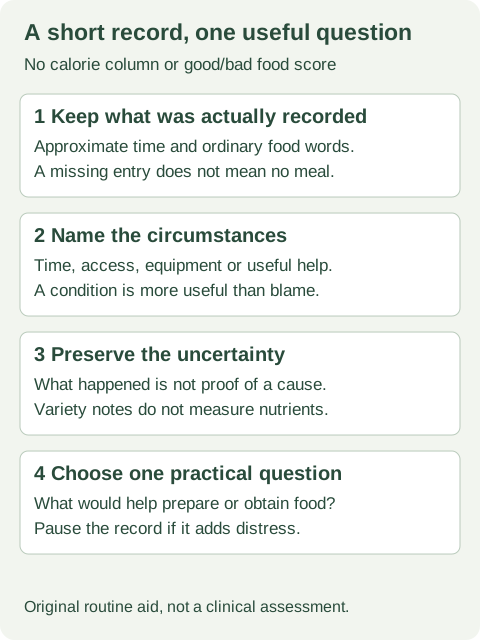
View the four-step review diagram
Read the recorded entries and look for a specific repeated circumstance. “The two lunches I recorded on travel days were difficult to arrange” is narrower and more accurate than “I always eat badly when travelling.” State the days or entries that support the observation and keep unrecorded days out of the conclusion.
Separate what happened from a possible explanation. You might notice that meals were easier when ingredients were already available. That suggests a shopping or preparation question; it does not prove that advance preparation improved health. A familiar meal that appeared several times might simply be convenient or enjoyable. Repetition is not automatically a lack of variety, and variety on the page does not establish that every nutrient need was met.
The NHS Eatwell Guide describes food-group balance over a day or even a week rather than requiring every meal to reproduce the same proportions. That provides general context for thinking beyond a single meal. It does not turn this diary into a validated diet assessment. Medical needs and special dietary requirements may need advice from a registered dietitian or the relevant care team.
Use three short review sentences: “I recorded…”, “The circumstances I noticed were…”, and “One practical question for next week is…”. If you have no clear pattern, write that. You can still choose a simpler record or solve an obvious access problem without claiming that the week revealed a hidden cause.
Choose one preparation or access adjustment
Let the next action answer the question you actually observed. If breakfast was easier with one familiar ingredient available, put that ingredient on the next shopping list in a realistic quantity. If lunch was difficult because there was no break, consider a workable break arrangement or appropriate support before assuming another recipe solves the problem.
Choose a change that fits your circumstances: repeat a familiar meal, coordinate one cooking task with someone else, check the equipment available, or buy a package size you can use. Do not buy seven days of prepared food without checking product-specific storage and handling. A diary week is a record window, not a refrigerator-life guarantee.
The weekly breakfast shopping worksheet turns intended mornings into ingredient quantities and usable inventory. Use it when the diary identifies a purchasing question. The repeatable breakfast ideas offer ordinary food combinations when you want another suitable option. Neither follow-up requires assigning the week a score.
Keep the proposed change separate from a predicted result. “Arrange ingredients for Monday” is a plan you can check. “This will prevent cravings or fix digestion” is a health claim that this record has not established. Review whether the practical task became easier, and retain or change that task according to what actually happened.
Keep symptom and distress questions with appropriate care
A routine record can help you describe what happened, but it cannot diagnose food allergy, intolerance, IBS or the cause of discomfort. A symptom following a mixed meal does not isolate one ingredient. Avoid elimination diets, deliberate reaction tests or changing prescribed treatment on the strength of a short record.
NIDDK explains that doctors assess symptoms, medical and family history and perform an examination when diagnosing IBS; other tests may be used to investigate conditions with similar symptoms. Its page was last reviewed in November 2017. It supports the distinction between a home note and clinical assessment here, not a diagnosis checklist to apply to yourself. Seek appropriate medical advice for persistent or concerning symptoms rather than extending this diary until it seems to prove a cause.
If keeping the record increases guilt, repeatedly checking entries, strict food rules or avoidance of eating, pause this optional exercise. A calorie-free format is not automatically suitable for everyone. NHS guidance identifies very strict food habits and concerns about eating among reasons to consider help; if you think you may have an eating disorder, it advises seeing a GP as soon as possible. This guide does not diagnose those experiences or replace a treatment plan.
You can use a simpler practical note such as “food available for tomorrow?” without listing every meal, or use no record at all. If a clinician requested monitoring, tell them when it becomes difficult so the format can be discussed. The purpose is useful information and appropriate support, not a perfect week of entries.
Six original checks before interpreting the record
These fictional situations test missing information, memory, practical constraints and the limits of a diary. Open each explanation to check the next reasonable step; they are not patient examples or a clinical assessment.
Case 1
Tuesday’s lunch row is blank. May the weekly review count that as proof that you ate no lunch?
Show answer and explanation for case 1
No. Mark it not recorded, unless you actually know that no meal was eaten.
Missing information and a known missed meal are different facts. Do not convert a diary gap into an eating pattern or a personal score. If you remember only the setting, keep that setting and leave the food unknown.
Case 2
On Friday you remember having a sandwich earlier in the week but cannot remember the time or all its fillings. How should the entry read?
Show answer and explanation for case 2
Use remembered, approximate and unknown where they belong.
Write what you genuinely recall, such as sandwich, day uncertain, recalled Friday. Do not turn a reconstructed memory into a precise contemporaneous record. A shorter honest entry remains useful for a preparation question.
Case 3
Two entries describe meals that were difficult to arrange on days with no reliable break. Is stricter calorie tracking the diary’s demonstrated solution?
Show answer and explanation for case 3
No. The notes point to a practical access or scheduling question.
Consider whether a break, suitable available food, shared preparation or a change in the work arrangement could help. The record has not measured calorie needs or established a lack of discipline. Choose a realistic next question rather than increasing the scoring burden.
Case 4
Discomfort followed one meal containing yogurt, bread and fruit. Does that prove yogurt caused it or that you have an allergy?
Show answer and explanation for case 4
No. A time sequence in a short diary does not establish a cause or diagnosis.
Keep the actual observation if it is useful for an appropriate healthcare conversation. Do not start an elimination diet or deliberate reaction test from this row. NIDDK describes diagnosis as a clinician’s assessment of symptoms, history and examination, with tests where appropriate to investigate other conditions.
Case 5
The week includes several different food groups. Can you certify that it met your nutrient needs without quantities or an appropriate assessment?
Show answer and explanation for case 5
No. Variety notes are not a nutritional adequacy calculation.
The NHS Eatwell Guide provides general food-group context across a day or week; it does not validate this diary or assess an individual’s needs. This record can support practical meal choices without claiming a measured nutrient intake.
Case 6
You repeatedly reopen the diary to make it perfect and feel guilty about eating something that is not entered. Should you add more fields?
Show answer and explanation for case 6
No. Pause this optional exercise and seek appropriate support if the concern continues.
A routine aid is not useful when it adds distress or strict control around food. NHS guidance identifies very strict food habits and worries about eating as reasons to consider help. This is not a diagnosis; if you think you may have an eating disorder, the NHS advises seeing a GP as soon as possible.
Sources and further reading
- NHS: The Eatwell GuideGeneral food-group variety and balance across a day or week, with individual adaptation for medical or special dietary requirements. It does not validate this original diary or give it a nutrient-adequacy score.
- NHS: Overview — Eating DisordersConcerns about strict food routines, distress and getting appropriate help. No inference that ordinary recording causes an eating disorder or that the diary diagnoses one.
- NIDDK: Diagnosis of Irritable Bowel SyndromeClinical diagnosis involves symptoms, medical and family history and examination, with investigation of other conditions when appropriate. A short routine diary cannot diagnose IBS, allergy or the cause of a symptom.