Practical guide
A Weekly Breakfast Shopping List from Three Flexible Templates
Count the people eating each morning, choose three familiar breakfast templates and combine matching ingredients. Then deduct usable inventory once and choose actual packages. Use the calculator, shopping worksheet and worked examples to keep food quantities, package excess and storage decisions clear.
Count the breakfasts you will actually eat
Start with your calendar, not a list of foods that sound healthy. Mark the mornings when breakfast will be eaten at home, how many people need it and which familiar breakfast is realistic. A person eating elsewhere does not need an extra home portion that day. If plans are uncertain, leave a note and choose a flexible food rather than buying for an invented commitment.
This guide is a purchasing worksheet for ordinary adult households. Choose quantities that fit the people eating; the amounts in the worked example are fictional arithmetic, not recommended serving sizes, tested recipes or a prescribed diet. If people need different amounts, make separate plans and combine only matching food quantities afterward. Medical dietary requirements and allergies need suitable individual choices.
| Morning | Template | People eating |
|---|---|---|
| Monday | A | 2 |
| Tuesday | B | 2 |
| Wednesday | A | 2 |
| Thursday | C | 2 |
| Friday | A | 2 |
| Saturday | B | 2 |
| Sunday | C | 2 |
There are seven mornings and fourteen people-mornings: template A is used for six, B for four and C for four. Counting people-mornings makes a changing household easier to plan than multiplying every food by seven. The same method works when Tuesday needs one person, Saturday needs three and Sunday needs none.
Consider time as well as headcount. A breakfast requiring cooking may fit a weekend but not a rushed weekday. Plan the foods you will actually use before adding optional extras. A shopping list cannot tell you whether you will enjoy a meal or whether its quantities suit your appetite.
Build three familiar templates and choose substitutions
Use three repeatable combinations as a starting point: an oat or cereal breakfast, a yogurt or suitable alternative bowl, and toast or another savory base. These are organizational templates. They do not guarantee an equivalent nutrient profile, fit every dietary restriction or describe a complete recipe.
| Template | Chosen item | Planning quantity |
|---|---|---|
| A | Dry porridge oats | 40 g |
| A | Chosen milk | 150 mL |
| A | Chosen prepared fruit | 100 g |
| B | Chosen yogurt | 150 g |
| B | Dry porridge oats | 30 g |
| B | Chosen prepared fruit | 100 g |
| C | Chosen bread | 2 pieces |
| C | Cooked ready-to-use beans | 100 g |
| C | Chosen prepared fruit | 100 g |
Write the exact food and preparation state you intend to purchase or use. “Chosen prepared fruit” means the same chosen item in this arithmetic example; fresh berries, drained canned fruit and a different frozen mix are not automatically the same inventory. Likewise, dry beans and cooked beans are different quantities, and different breads may have different slice sizes.
A substitution needs a new quantity decision. Replacing yogurt with a plant alternative, bread with another base or oats with cereal does not preserve protein, fiber, allergens or liquid needs automatically. Check the actual product and preparation instructions, then enter the amount you intend to use. The label-based breakfast worksheet handles nutrient arithmetic separately; this tool handles shopping quantities.
The NHS Eatwell Guide describes balance across a day or week, with variety among food groups. It is useful context for the wider pattern of eating, rather than a requirement that every breakfast reproduce the guide. Keep other meals in view and select suitable foods; do not use this grocery calculation as a medical diet assessment.
Combine the same food, keeping units separate
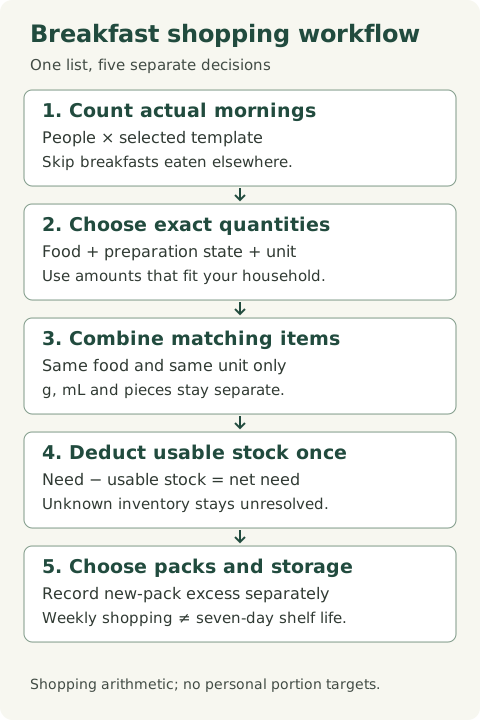
Multiply each selected ingredient quantity by that template’s people-mornings, then combine only matching foods in matching units. For the example, oats appear in two templates: 40 g × 6 plus 30 g × 4 gives 360 g. Fruit appears in all three: 100 g × 14 gives 1,400 g.
| Chosen item | Calculation | Quantity needed |
|---|---|---|
| Dry porridge oats | 40 × 6 + 30 × 4 | 360 g |
| Chosen milk | 150 × 6 | 900 mL |
| Chosen prepared fruit | 100 × 14 | 1,400 g |
| Chosen yogurt | 150 × 4 | 600 g |
| Chosen bread | 2 × 4 | 8 pieces |
| Cooked ready-to-use beans | 100 × 4 | 400 g |
Grams, milliliters and pieces remain separate. A 400 g can is not necessarily 400 g of drained beans. A loaf is not one breakfast piece if your planning unit means a slice. Use a checked drained weight, actual slice count or appropriate recipe yield when it is available. Leave an uncertain conversion unresolved instead of silently treating package weight, edible weight and volume as equal.
Shared ingredients can simplify shopping, but only when they really are interchangeable for your plan. If one household member uses lactose-free milk and another uses a different milk, give them different names. The calculator trims spaces and ignores capitalization when grouping names; it cannot judge product equivalence, ingredient safety or preparation state.
Calculate needs, then deduct usable inventory
Open the weekly breakfast shopping list tool. Enter the template and whole number of people for each morning. A blank headcount means zero planned people. Enter up to three foods per template, their amounts per person and either g, mL or pieces. Blank ingredient rows can be omitted; a used template needs at least one positive ingredient quantity.
Select Calculate quantities needed to see the combined list. Then enter the amount of each matching food already available and usable for the planned mornings. Count stock once against the combined need, not once for every template using it. The stock fields start at zero, meaning no inventory has been deducted; this is not an inventory inspection. Clear a field when its quantity is unknown.
Select Calculate shopping list. The result shows needed quantity, usable stock, quantity to buy and existing stock left after the plan. Unknown stock stays unknown and the buying quantity stays unresolved. The calculation cannot establish whether food has been safely stored, whether it is still suitable or whether an opened item will last until the planned day.
Changing the morning plan or any ingredient clears the old needs and shopping results. Changing stock clears the old shopping result while retaining the current combined needs. Recalculate after changes. Clear all inputs removes the current plan; Load fictional example fills the arithmetic example for you to edit and calculate. The tool works in your browser without an account or sending its entries to a server.
For example, 360 g of needed oats minus 100 g of usable oats leaves 260 g to buy. For milk, 900 mL needed with 950 mL available leaves zero to buy and 50 mL of existing stock after the plan. Those 50 mL are useful only if they remain suitable when you intend to use them. The tool does not add excess from packages you have not purchased.
Turn the net need into packages and a surplus plan
A net ingredient amount is not always a purchasable package size. After calculating the list, check the actual packs available, how much edible product they supply, price, storage space and how you will use any excess. Record the chosen purchase separately from the calculator’s result.
| Quantity | Fictional oat example | Meaning |
|---|---|---|
| Need after stock | 260 g | 360 g planned minus 100 g already usable |
| Chosen purchase | One 500 g pack | Actual package you decide to buy |
| New-pack excess | 240 g | 500 g purchased minus 260 g used from that pack |
| Existing stock left | 0 g | The original 100 g was fully allocated |
The 240 g of new-pack excess is different from “stock left after plan” in the tool. That tool column describes only the inventory you entered before shopping. To calculate total surplus after buying, include the actual purchased quantities yourself. If an item has uncertain edible yield, resolve that before deciding how many packs cover the need.
Give each surplus a realistic destination: unopened dry oats for a later plan, suitable bread portions stored according to the product guidance, or an extra familiar meal that actually appears on your calendar. Do not invent another breakfast solely to justify a large pack. Compare total spend and likely use, as well as a unit price; a lower price per gram does not help if the food is discarded.
Check substituted products again when shopping. A different pack size, drained weight, slice count or ingredient list can change the plan. Keep an unresolved item on the paper sheet rather than marking the entire list finished. For fresh, frozen and canned options, use the breakfast fruit label guide before choosing the product and preparation state.
Separate a weekly purchase from a safe preparation schedule
Buying for a week does not mean preparing seven days of mixed breakfasts at once. Plan storage and preparation for the actual foods, package instructions and recipes. Some ingredients may be purchased for later use while others need a later shopping trip, suitable freezing or preparation close to the meal. This worksheet provides no universal seven-day refrigerator life.
The FDA advises keeping the refrigerator at 40°F or below and checking it with an appliance thermometer. Avoid overpacking so cold air can circulate, cover food and refrigerate perishables promptly. Its maximum room-temperature limits are two hours, or one hour when the temperature is above 90°F; those are limits, not instructions to wait before refrigerating.
For cooked leftovers, divide food into smaller, shallow containers and refrigerate promptly. The FDA notes that hot food can go into the refrigerator; leaving a large batch out overnight to cool is not a safe workaround. Keep raw meat, poultry, seafood and eggs separate from ready-to-eat food. Clean hands and preparation surfaces, and follow suitable food-specific instructions.
Label prepared components with what they are and when they were prepared, and keep the relevant storage instructions accessible. A pleasant smell or appearance does not prove food is safe. Freezing does not undo unsafe handling that happened before freezing. If the storage history or suitability is unresolved, do not count that food as confirmed usable inventory.
Use the component-based meal prep guide to plan manageable sessions, and the meal prep zone guide to arrange cleaning, containers and refrigerator space. If you choose a specific overnight-oats recipe, use the recipe-specific scaling worksheet rather than treating the fictional quantities here as a recipe.
Use the worksheet and check eight common decisions
Download the breakfast shopping worksheet for a seven-morning grid, ingredient quantities, usable inventory and a separate package-surplus plan. Duplicate rows when your household needs more than three items per template or different amounts per person. The diagram keeps the steps in order; try the decisions below before opening the answers.
Case 1
Oats appear as 40 g for six people-mornings and 30 g for four. What quantity belongs on the combined needs list?
Show answer and explanation for case 1
360 g of the same dry porridge oats.
Calculate 240 g + 120 g. Combining requires the same chosen food and preparation state; a different cereal stays separate.
Case 2
The combined oat need is 360 g and 100 g are confirmed usable. How much is needed from shopping?
Show answer and explanation for case 2
260 g.
Deduct the 100 g once from the combined total. Deducting it separately from templates A and B would count the same inventory twice.
Case 3
You need 900 mL of milk and have 950 mL usable for the planned days. What does the tool show?
Show answer and explanation for case 3
Buy 0 mL; existing stock left after the plan is 50 mL.
The remaining amount is arithmetic. Its later use still depends on the actual product instructions and storage history.
Case 4
Two rows use the same name but one is measured in g and the other in mL. Should the tool merge them?
Show answer and explanation for case 4
No. They stay in separate quantity groups.
Mass and volume are not interchangeable without an appropriate checked conversion. The tool does not guess density or preparation yield.
Case 5
You do not know how much prepared fruit is usable. What should go in the stock field?
Show answer and explanation for case 5
Leave it blank so inventory is Unknown and buying quantity is Unresolved.
Zero means you are deducting no stock. A blank field preserves the missing fact instead of presenting an apparently finished net list.
Case 6
You need eight bread pieces, but the pack listing says one loaf. Is one loaf enough?
Show answer and explanation for case 6
The quantity is unresolved until the planning piece and actual usable count are checked.
If your piece means a slice, check the loaf’s actual slice count and what remains usable. Do not assume a loaf, slice and serving are equal units.
Case 7
Template C is not selected for any morning, and its ingredient rows are blank. Must you fill those rows?
Show answer and explanation for case 7
No. An unused template is ignored.
At least one positive ingredient is needed for each used template, but unused templates do not create artificial shopping needs.
Case 8
Seven mornings are on the shopping plan. Does that establish seven days of refrigerator life for prepared breakfasts?
Show answer and explanation for case 8
No. Storage suitability must be established for the actual food and preparation.
A weekly purchasing horizon is not a food-storage guarantee. Use current package or recipe instructions, safe handling and a suitable preparation schedule.
Adjust the next plan using what actually happened
After the planned mornings, record which meals were eaten, which were changed and what remained. A missed home breakfast changes ingredient demand; a disliked combination changes the template. Adjust the next plan from these observations rather than copying seven days mechanically or adding more foods for variety that nobody intends to use.
Start with the usable inventory that really remains, check its suitability for the next plan and choose the next actual mornings. If a package repeatedly produces unwanted excess, try a different size, a suitable alternative or a shorter purchase interval. Keep costs, access to shops, storage space and preparation time visible in the decision.
A useful completed list has matching food names, appropriate units, checked inventory and a feasible storage plan. It can remain short. Use the broader meal-led grocery list guide to coordinate breakfast purchases with other meals. This tool’s success is a workable list for your household; it does not measure nutritional adequacy or predict health outcomes.
Sources and further reading
- NHS: The Eatwell GuideFood-group variety and balance across a day or week; not a prescribed quantity for every breakfast.
- FDA: Refrigerator Thermometers — Cold Facts About Food SafetyRefrigerator temperature, prompt storage, shallow containers, cold-air circulation, separation and room-temperature limits; no universal seven-day food life inferred.