Gut-Friendly Foods: Everyday Fiber and Probiotic Limits
Revised · General adult food education
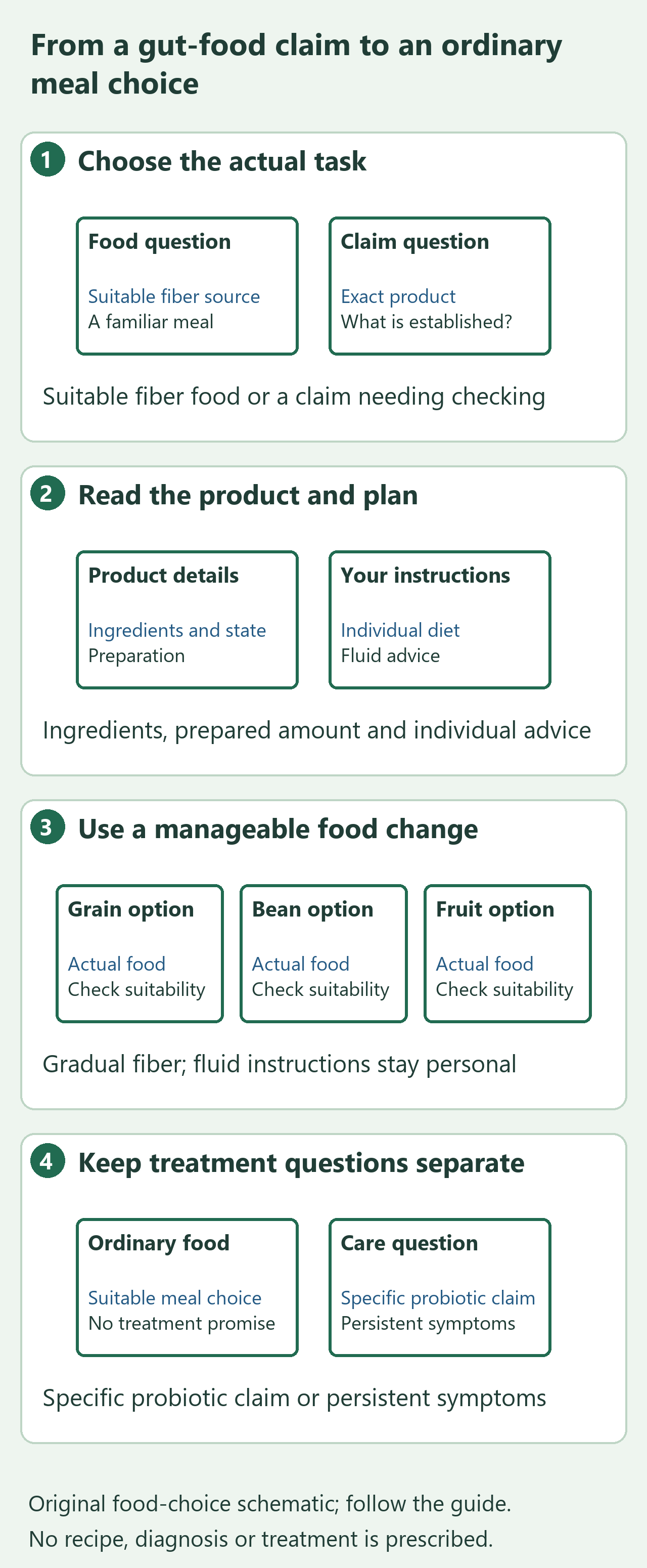
For ordinary meal planning, begin with familiar fiber-containing foods and changes you can manage. “Gut-friendly” is not a diagnosis, a measured microbiome score or proof that a food treats symptoms. Keep product ingredients, comfort and individual dietary advice visible, especially when probiotic claims enter the decision.
Make “gut-friendly” a specific food question
A useful question is “Which suitable fiber-containing food could fit the meal I already eat?” That is easier to act on than “Which food will heal my gut?” This guide covers ordinary meal choices and label distinctions. It does not diagnose IBS, food allergy or intolerance, prescribe an elimination diet, or identify a food that will treat everyone’s digestive symptoms.
Start with familiar foods, your current requirements and the preparation you can manage. A food described as beneficial in general can still be unsuitable for a particular allergy, medical diet or texture requirement. Follow any prescribed low-fiber diet, fluid restriction or other individual instructions rather than treating a general fiber suggestion as a reason to override them.
Choose fiber sources across foods you already use
NIDDK’s constipation nutrition page lists whole grains, legumes, fruits, vegetables and nuts as fiber sources. It gives concrete examples such as oatmeal, lentils, black beans, pears, carrots and almonds. We use that food list and its gradual-change advice here; its constipation context does not establish a cure for every gut complaint.
On a narrow screen, scroll this table sideways to read all columns.
| Food group | A familiar example | A manageable meal choice | What to check |
|---|---|---|---|
| Whole grains or higher-fiber starches | Oatmeal, wholewheat bread or pasta | Use a suitable familiar option for one meal | Exact product, preparation, ingredient requirements and label fiber basis |
| Legumes | Cooked lentils, chickpeas or beans | Include a suitable amount in a soup, toast meal or mixed dish | Cooked versus dry quantity, product instructions and relevant dietary advice |
| Fruit | Pears, berries or oranges | Choose fruit you enjoy and can prepare and store | Actual format, ingredients, storage and texture needs |
| Vegetables | Carrots, broccoli or green peas | Use a suitable vegetable with an existing meal | Preparation, access and what you will actually eat |
| Nuts | Almonds, peanuts or pecans | Use an appropriate food and amount when it fits | Allergies, ingredients, texture and personal suitability |
The table is a set of editorial meal choices, not tested recipes or equivalent fiber portions. A particular bread, canned bean recipe or mixed product needs its own information. “Contains whole grains” and an attractive fruit photograph do not supply a gram amount for the food you actually eat.
For packaged foods, read the fiber row with the reference quantity. A higher figure per larger serving may not mean higher fiber at equal weight. The cereal comparison guide explains that calculation; the whole-label walkthrough places it alongside ingredients and other nutrient checks.
Make a gradual change instead of maximizing a score
NIDDK advises adding fiber a little at a time so the body gets used to the change. For an ordinary meal adjustment, choose one suitable food or a manageable change in the amount you already use. You do not have to add beans, bran, several fruits and a supplement in the same morning.
For example, you could use a familiar higher-fiber bread for one meal, include an appropriately prepared bean component, or choose a fruit you will use. Pick the change that fits your access and dietary advice. These examples organize choices; they do not specify a clinical dose or promise a particular bowel response.
NIDDK also discusses liquids and advises asking a health professional about needs that depend on health and circumstances. This page does not set a universal number of glasses or tell someone with a fluid restriction to drink more. Keep your established fluid instructions with the food plan.
If a new food is uncomfortable, reconsider the amount, preparation and whether the change fits you. Do not use discomfort as proof that you must intensify a “gut reset.” Persistent or concerning symptoms belong in a healthcare conversation. A meal note can describe an experience, but cannot establish which ingredient caused it.
Fiber, prebiotics and probiotics are different terms
Fiber is the nutrient category you can look for on a food label. NCCIH describes prebiotics as nondigestible food components that selectively stimulate the growth or activity of desirable microorganisms. It describes probiotics as live microorganisms intended to have health benefits when consumed or applied to the body. The terms are not interchangeable.
A fiber gram figure alone does not establish a specific prebiotic effect. A food containing a fiber source is not therefore a verified probiotic treatment. Likewise, the name of a bacterial group does not prove that every product containing a member of that group has the same effect.
NCCIH notes that different probiotics can have different effects and that important uncertainties remain about helpful products, amounts and who benefits for particular conditions. Those limitations are a reason to keep a food preference separate from a treatment promise, rather than buying whichever supplement advertises the largest number.
Read fermented-food and supplement claims by the actual product
NCCIH says probiotics can be found in yogurt and other fermented foods, as well as supplements and other products. That statement does not establish that every yogurt or fermented food has a proven effect for your symptoms. “Fermented,” a culture claim and demonstrated benefit for a specific condition are different pieces of information.
If choosing a yogurt or another packaged food, read its actual ingredients, relevant culture information, preparation and storage instructions. Choose something suitable that you enjoy using as food. If a probiotic claim is the main reason for a purchase, ask what exact product, microorganisms and outcome the claim refers to; leave missing information unresolved.
You can make an ordinary meal from suitable foods without buying a probiotic supplement. NCCIH advises consulting a healthcare provider when considering such supplements, especially with health problems. It notes greater risks in people with severe illnesses or compromised immune systems and says not to postpone care because of probiotics. This page does not recommend a strain, dose or treatment course.
Keep food variety and the actual meal together
The NHS Eatwell Guide describes variety and balance over a day or week rather than requiring one meal to include every category. You can choose different suitable foods across the meals you actually eat. There is no target here to buy a particular number of plants, complete a microbiome score or treat a repeated familiar meal as a failure.
For breakfast, the nine repeatable combinations provide practical options. For purchasing, the meal-led grocery list keeps ingredients tied to real meals, usable stock and storage. Choose a manageable addition rather than an assortment you cannot prepare or finish.
If recording would help a practical question, keep the actual food and preparation in ordinary words and retain uncertainty. The optional routine diary explains why a short sequence of meals cannot diagnose a symptom’s cause. If tracking adds distress or strict food control, skip this optional record and use appropriate support.
The useful result is one suitable food choice you can prepare and repeat, with medical questions kept in the appropriate setting. A larger fiber number or more impressive probiotic label is not proof that the whole choice is better for you.
From a gut-food claim to an ordinary meal choice
Examples to work through
These fictional examples illustrate practical choices and observations.
Several new fiber foods and a supplement go into one breakfast
For an ordinary food change, use NIDDK’s gradual approach rather than maximizing everything at once. Choose a suitable manageable change and follow individual dietary advice. A general fiber list does not set a personal dose or guarantee a particular response.
A yogurt says fermented, so it seems like an IBS treatment
Keep the food description and treatment claim separate. NCCIH says probiotic effects can differ and important product and benefit uncertainties remain. Read the exact ingredients and use appropriate care for symptoms; a fermentation word does not establish treatment.
A prescribed low-fiber diet conflicts with a wholegrain suggestion
Follow the prescribed plan and ask the relevant care team about changes. This general food-choice guide does not override a low-fiber diet or fluid restriction. A food’s general nutrient role is different from its suitability for your current needs.
Discomfort followed a mixed meal containing three ingredients
Keep the observation without identifying a culprit from the sequence alone. A short note is not a diagnosis of allergy, intolerance or IBS. Do not perform deliberate reaction tests or start an elimination diet from this example; discuss persistent concerns with an appropriate professional.
Fiber-food choice and claim-check record
Use these optional reminders to mark fields you want to keep in your own notes. The downloadable blank sheet contains every record field. Keep your completed record in your own appropriate private place.
Frequently asked questions
What everyday foods can contribute fiber?
NIDDK lists whole grains, legumes, fruits, vegetables and nuts, with examples such as oatmeal, lentils, pears and carrots. Choose foods that fit your actual requirements and preparation. The list is not a set of equivalent portions or a treatment for every digestive symptom.
Should I make a large fiber increase immediately?
NIDDK advises adding fiber a little at a time. Choose a manageable suitable change and follow any prescribed diet or fluid instructions. This page does not set a universal fiber dose, glass count or deadline for a particular bowel response.
Are prebiotics and probiotics the same?
No. NCCIH describes prebiotics as nondigestible food components selectively affecting desirable microorganisms, and probiotics as live microorganisms intended to provide health benefits. A fiber value or product category alone does not establish a specific effect or personal suitability.
Do I need a probiotic supplement to choose gut-friendly foods?
A supplement is not required for this ordinary meal-planning task. Choose suitable foods. NCCIH advises consultation when considering probiotic supplements, especially with health problems, and warns against postponing care. This guide recommends no strain, dose or condition-specific treatment.
Sources and what they support
- NIDDK: Eating, Diet, & Nutrition for Constipation
Specific fiber-containing foods, gradual increases and individualized liquid guidance. This constipation page was last reviewed May 2018; the food list does not establish treatment for every digestive concern.
- NHS: The Eatwell Guide
Ordinary food groups, protein foods and balance over a day or week. The source displays a last-reviewed date of 29 November 2022; use individual advice for medical dietary requirements.
- NCCIH: Probiotics—Usefulness and Safety
Probiotic and prebiotic definitions, differences between products, benefit uncertainties and supplement cautions. The page displays Last Updated: August 2019. A food category does not establish a personal treatment.
- NHS: Overview—Eating Disorders
Food worries, strict routines and getting appropriate help. Last reviewed 23 January 2024. A craving or an optional food note is not diagnosed as an eating disorder.
- FDA: How to Understand and Use the Nutrition Facts Label
US serving quantities, matching comparisons, nutrient grams versus %DV, and added sugars already included in total sugars. The source is dated 5 March 2024; label references are not personal meal targets.
Sources were checked on 4 November 2026 UTC. The food-choice examples, arithmetic and blank records are original editorial aids, not tested recipes, nutrient analyses or medical assessments.